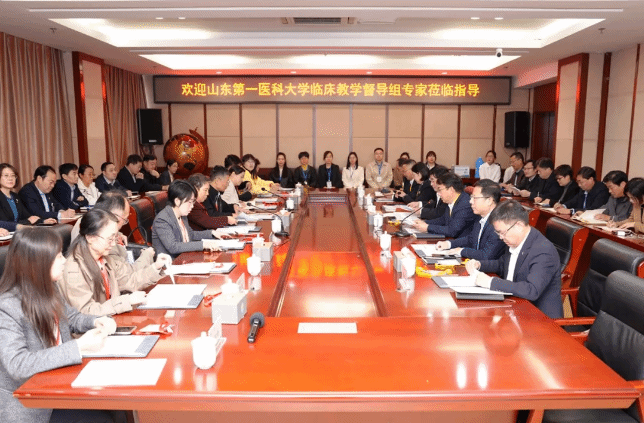
On October 27, 2026, the clinical teaching supervision expert group of Shandong First Medical University (Shandong Academy of Medical Sciences) came to our hospital to carry out the 2026 annual clinical teaching supervision inspection. Our hospital attached great importance to the inspection, made careful arrangements, and fully completed all preparatory work, ensuring the successful completion of the clinical teaching supervision.
The expert group was led by Li Xiaoyu, former Party Secretary and Vice President of the Aerospace Center Hospital of Peking University, as group leader, and Lv Huxiao, Deputy Director of the Medical Management Department of the University , as team leader. Other experts came from the Affiliated Provincial Hospital and the First School of Clinical Medicine. The supervision was divided into three parts: a teaching work report, on-site teaching inspection, and supervision feedback.
The teaching work report meeting was presided over by Xiao Qiang, Deputy Party Secretary and President of the hospital. All other hospital leaders, heads of functional departments, directors of teaching and research sections, and teacher representatives attended the meeting. At the meeting, Cao Mingfeng, Party Secretary of the hospital, delivered a welcome speech on behalf of the hospital. He briefly introduced the hospital’s clinical teaching and high-quality development, and stated that the hospital would fully cooperate with the supervision work and humbly accept the experts’ guidance. Li Xiaoyu introduced the key contents and work requirements of this clinical teaching supervision. Vice President Liu Wei reported on the hospital’s clinical teaching work from the aspects of teaching organization and management, practical teaching, faculty development, teaching support, and student training, and gave a detailed report on the development of the Clinical College and the rectification of feedback from teaching supervision in 2024 and 2025.
Through methods such as “listening, observing, checking, visiting, and interviewing,” the expert group carried out an all-round and multi-dimensional inspection and evaluation of the hospital’s clinical teaching work. The experts held symposia with hospital leaders, middle-level cadres, teachers, and students to gain an in-depth understanding of the top-level design, organizational management, and implementation of responsibilities in clinical teaching, as well as the opinions and suggestions of teachers and students. They observed on site teaching rounds, clinical clerkship teaching, and theoretical lectures, focusing on teaching preparation, teaching standards, teaching processes, teacher-student interaction, and teaching effectiveness. They visited the Clinical Skills Center to learn in detail about the development of the skills training platform, equipment configuration, and operation and use. They carefully reviewed teaching archives and materials concerning teaching management and teaching operation, and checked item by item the implementation of teaching systems, execution of teaching plans, teaching process management, and assessment and evaluation. They also visited student dormitories, classrooms, canteens, the Physical Examination Center, and other places to comprehensively understand students’ study and living conditions and teaching support facilities. During the inspection, the expert group adhered to a problem-oriented approach, providing feedback and guidance while inspecting. They spoke highly of the hospital’s clinical teaching organization and management, practical teaching, and teaching support conditions, while objectively pointing out existing shortcomings and directions for improvement in clinical teaching.
At the feedback meeting, Cao Mingfeng expressed gratitude on behalf of the hospital for the expert group’s hard work and careful guidance. He said that the problems fed back by the expert group were objective and fair, and that the opinions and suggestions put forward were highly targeted and instructive. The hospital sincerely accepted all feedback in full. Cao Mingfeng stressed that the hospital would take the rectification of the problems fed back in this supervision as an important lever for improving clinical teaching quality, and would focus on the following aspects: First, raise the political stance, strengthen the main responsibility for clinical teaching, and implement the fundamental task of fostering virtue through education in all aspects of clinical teaching. Second, adhere to immediate rectification, establish lists of problems, responsibilities, and rectification tasks, clarify responsible persons and rectification deadlines, implement check-off management, and ensure that every item is addressed and every issue receives a response. Third, focus on drawing inferences from one case to another, dig deep into the root causes of problems in systems and mechanisms, faculty development, teaching operation, and quality monitoring, so that rectifying one problem improves a set of systems and standardizes one field. Fourth, strengthen evaluation-driven construction, improve long-term mechanisms for clinical teaching, and transform rectification results into tangible outcomes in improving the quality of clinical talent training. The hospital will hold dedicated meetings to study rectification work, regularly schedule rectification progress, and ensure that rectification responsibilities are tightly pressed and rectification tasks are implemented in a closed-loop manner.
In the future, our hospital will take this clinical teaching supervision as an opportunity to carefully sort out the expert group’s feedback, establish a rectification ledger, implement rectification and improvement item by item, continuously strengthen the main responsibility for clinical teaching, consolidate the foundation of teaching management, optimize practical teaching links, continuously improve the quality of clinical talent training, and push the hospital’s clinical teaching work to a new level.
