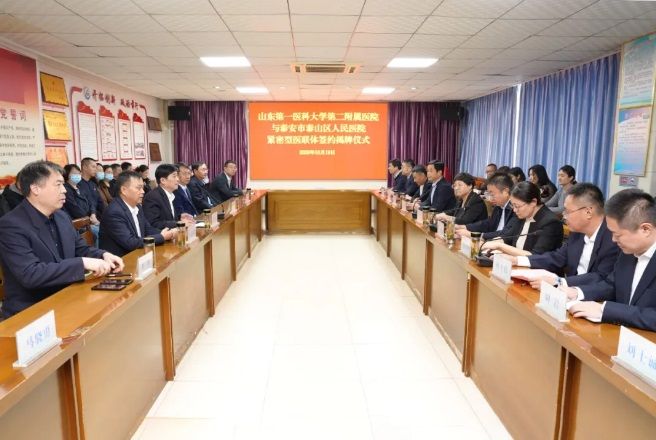
To thoroughly implement the arrangements for deepening reform of the pharmaceutical and healthcare systems, advance the healthcare foundation-strengthening project, build a full-life-cycle health service chain integrating prevention, treatment, rehabilitation, and management, and promote the expansion and downward flow of high-quality medical resources, the unveiling ceremony for the compact medical consortium between the Second Affiliated Hospital of Shandong First Medical University (The Second School of Clinical Medicine) and Taishan District People's Hospital was held at Taishan District People's Hospital on the afternoon of October 19.
Zhang Ling, Deputy District Head of Taishan District People's Government; Fang Ming, Secretary of the Party Leadership Group and Director of the District Health Commission, and relevant responsible officials; Cao Mingfeng, Party Secretary of The Second Affiliated Hospital of Shandong First Medical University; Xiao Qiang, Deputy Party Secretary and President; Fang Zhensheng, Party Committee Member and Vice President, and heads of relevant functional departments; the leadership team of Taishan District People's Hospital; and principal officials of primary healthcare institutions attended the ceremony. The ceremony was presided over by Fang Ming.
At the Opening Ceremony, Sun Fengwei from Taishan District People's Hospital extended welcome and thanked to the leaders and experts attending the event. He said that the establishment of the compact medical consortium is an important milestone in the hospital's high-quality development. The district people's hospital will leverage the high-quality medical resources of The Second Affiliated Hospital of Shandong First Medical University, improve regular collaboration mechanisms such as two-way referral and experts going down to the grassroots, continuously consolidate the foundation of medical services, and protect the life and health of the people in the jurisdiction.
Zhang Ling, Deputy District Head of Taishan District, on behalf of the district government, congratulated the establishment of the medical consortium. She pointed out that the joint construction by the two hospitals is a major livelihood project for optimizing the layout of medical resources in Taishan District. The district government will strengthen service guarantees, support both sides in continuously deepening cooperation, improve the hierarchical diagnosis and treatment system, and continuously enhance the people's sense of gain in seeking medical care.
Cao Mingfeng, Party Secretary of The Second Affiliated Hospital of Shandong First Medical University, said in his speech that forming a compact medical consortium is an important practice for promoting the expansion and downward flow of high-quality medical resources. The Second Affiliated Hospital of Shandong First Medical University adheres to the concept of "technology going down, management going down, and resource sharing," carries out in-depth collaboration in areas such as specialty co-construction, talent cultivation, and clinical teaching, and opens up the hierarchical diagnosis and treatment service chain, so that people can enjoy homogeneous high-quality medical services of a tertiary Grade A hospital at their doorstep.
Witnessed by the attendees, President Xiao Qiang and Sun Fengwei, responsible person of Taishan District People's Hospital, jointly signed the compact medical consortium cooperation agreement. Party Secretary Cao Mingfeng and Deputy District Head Zhang Ling jointly unveiled the "Compact Medical Consortium of the Second Affiliated Hospital of Shandong First Medical University," marking that the construction of the compact medical consortium between the two sides has officially entered a new stage of institutionalized and substantive operation.
In the future, The Second Affiliated Hospital of Shandong First Medical University will advance the construction of the compact medical consortium focusing on three priorities: management empowerment, technical assistance, and platform connectivity; build a hierarchical and linked service pattern of tertiary Grade A hospital—district people's hospital—primary healthcare service centers; continuously improve the standardized management level of chronic diseases in the region; and promote the improvement of quality and efficiency of the hierarchical diagnosis and treatment system.
