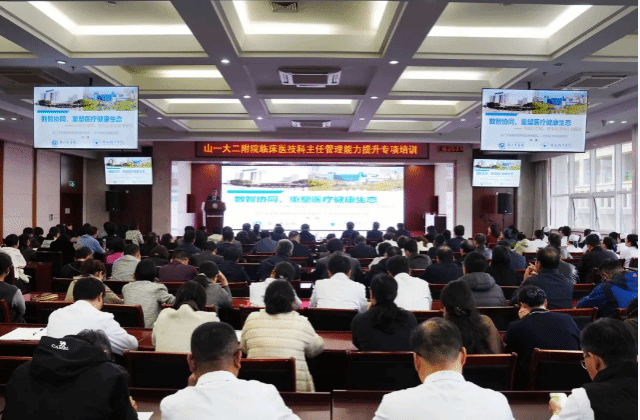
On the afternoon of November 6, our hospital held a special training program on management capability improvement for directors of clinical and medical technology departments. Professor Lin Hui, Director of the Office of Internet and Artificial Intelligence at Sir Run Run Shaw Hospital, Zhejiang University School of Medicine, was specially invited to give a lecture titled “Digital Reconstruction of the Healthcare Ecosystem and Discipline Construction.” Gou Yannong, Chairman of Shandong Kangjian Medical Management Research Center, attended and delivered remarks. Xiao Qiang, Deputy Secretary of the Party Committee and President of the hospital, delivered concluding remarks, and Fang Zhensheng, Member of the Party Committee and Vice President, presided over the training. Members of the hospital leadership team presented at the hospital, directors of clinical and medical technology departments, medical team leaders, head nurses, and heads of relevant functional departments participated in the training.
In his remarks, Gou Yannong pointed out that in the opening year of the 15th Five-Year Plan, digital-intelligent healthcare has entered a new stage characterized by data-driven and intelligent decision-making. From “informatization” to “digital intelligence,” the shift points to a systemic reshaping from the electronization of business processes to data-driven and intelligent decision-making. He urged colleagues to cherish the opportunity for learning and exchange, learn with questions in mind and think in light of actual conditions, translate what they learn into ideas and plans, and use digital-intelligence empowerment to improve the quality and efficiency of healthcare services.
Lin Hui is a Professor of Surgery, Chief Physician, and Doctoral Supervisor at Zhejiang University. He currently serves as Dean of the School of Medicine at Hangzhou City University, Director of the Zhejiang Provincial Key Laboratory of Medical Intelligent Decision-Making, and Director of the Office of Internet and Artificial Intelligence at Sir Run Run Shaw Hospital, Zhejiang University School of Medicine. He is a representative expert in the field of smart healthcare in China.
In his lecture, Professor Lin Hui began with the development history of artificial intelligence, guiding the audience to understand the essence of digital transformation from the underlying logic and to seek a certain development path in an era full of uncertainty. Using the generalization of operating systems to support application ecosystems as a metaphor, he systematically explained the evolution path driven by large models—“from large-scale medical knowledge to a clinical decision-making brain”—as well as frontier trends such as embodied intelligence. Combining the practices of Sir Run Run Shaw Hospital’s internet hospital and smart healthcare construction, he depicted a complete picture of digitally reshaping the healthcare ecosystem. He particularly emphasized that digital reshaping must always return to the essence of healthcare, take medical quality and patient safety as the bottom line, use data-driven approaches to fortify quality control defenses, and rely on intelligent decision-making to prevent diagnostic and treatment risks, so that technological progress can truly be transformed into a solid barrier for patient safety. The lecture was broad in vision and accessible in explanation, combining both strategic thinking and practical reference, and struck a strong chord among the attendees.
In his concluding remarks, President Xiao Qiang expressed sincere gratitude to Professor Lin Hui for his excellent lecture and to Chairman Gou Yannong for his presence and guidance. He noted that in recent years the hospital has adhered to digital-intelligence empowerment, steadily advanced management informatization and artificial intelligence applications, built the “Smart 100” 3.0 version, and relied on smart services to improve service efficiency; completed the local deployment of the DeepSeek large model and launched the virtual nurse “Anhao” cloud accompaniment service; established Tai’an’s first clinical and translational ward for brain-computer interfaces and implemented the “one code for all” medical service, with bedside admission and discharge accounting for more than 95%; digital intelligence is being deeply integrated into all aspects of medical services and hospital management. He required that directors of clinical and medical technology departments apply what they learn, transform frontier concepts into new ideas for discipline construction, new methods for department management, and new measures for serving patients, and transform learning outcomes into an internal driving force for promoting the hospital’s high-quality development.
Next, the hospital will continue to deepen digital and intelligent transformation, empower discipline construction and hospital management with digital intelligence, and inject new momentum into the hospital’s high-quality development.
